
Which sentence sounds more natural?
A We had powerful rain last night.
B We had heavy rain last night.
A I want to focus in my work.
B I want to focus on my work.
A I did a mistake.
B I made a mistake.
If any of these were immediately obvious to you without thinking about rules or definitions, how did you know?
Let’s try something else. Can you predict the next word?
- Once upon a _______________
- Ladies and _______________
- Thank you very _______________
- As soon as _______________
If you knew immediately, how did you know?
Our brains have something in common with AI: they are prediction experts. When you are speaking and I’m listening, my brain is predicting (subconsciously) what you will say next: the words and the structure.
Imagine that we can slow down time and pause before the last word:
I want to speak English more _____.
If we are talking about structure, my brain predicts an adverb. If we are talking about word choice, my brain predicts “fluently.”
I want to speak English more FLUENTLY.
That’s not the only possibility, but it’s the most likely, because I’m a teacher and you’re talking to me about improving your English. So that context makes “fluently” the most likely thing you will say next.
You might also choose a different adverb.
- I want to speak English more clearly.
- I want to speak English more accurately.
- I want to speak English more natively.
- I want to speak English more professionally.
You might say a whole phrase instead of an adverb.
- I want to speak English more like a native speaker.
- I want to speak English more often.
- I want to speak English more in meetings.
- I want to speak English more at home.
In this case, my brain will quickly adapt. You didn’t say what I thought you would say, but what you’re saying makes sense.
Now imagine that you say a noun instead.
❌ I want to speak English more fluency.
My brain registers an error. That’s not because I’m a teacher. The vast majority of native speakers will register that error even if they don’t know how to explain why it’s wrong.
You have probably had this experience in your native language. You know when something sounds strange or off in your language even if you don’t know every grammar rule and even if you can’t explain why it’s wrong.
If we register one minor error, we can usually figure it out. Fluency and fluently have the same root. The error itself is distracting, but we can get the point.
Types of errors
- Pronunciation
- Prepositions
- Articles
- Parts of speech
- Vocabulary / word choice
- Subject-verb agreement
- Word order
Imagine this sentence:
❌ A trick thing about the language is the all words are as puzzle but this form change depends in this all words around.
At this point, there are so many errors that a listener could lose the meaning.
From a teaching perspective, we can’t cover all of these mistakes in one lesson. The best I can do as a teacher is to rewrite the sentence completely:
✅ The hardest thing about language is that words are like puzzle pieces, but their shapes change depending on the context.
Two powerful ways to overcome habitual mistakes in speech
1 Conscious Correction
This could be called staying conscious, self-monitoring, or just slowing down and paying attention. This is when you:
- Notice the mistake while you’re speaking
- Remember the correct form
- Deliberately substitute it
This is mentally demanding. It requires the kind of sustained attention and awareness that people spend years developing through meditation. You can and should try to practice this when you speak in class. But most people won’t be able to do this continuously. You will lose focus.
2 Developing Automatic Language Habits
This is repetition of input and output. It means you:
- Encounter correct language patterns repeatedly
- Develop familiarity with what “sounds right”
- Become increasingly capable of noticing what “sounds wrong” without analyzing grammar or vocabulary
- Practice producing the correct patterns until they become automatic
This approach can feel deceptively simple, silly, or even childish. If it feels childish, that’s ok. Remember that children learn language more easily than you 🙂
Consider these everyday examples of automaticity:
An accomplished pianist can pay close attention to the music while playing without consciously deciding where to position every finger.
An experienced driver can monitor traffic without consciously thinking through every movement of the steering wheel.
A fluent speaker can be fully engaged in a conversation without consciously assembling every grammatical structure.
Automaticity doesn’t eliminate awareness. It frees attention for higher-level tasks.
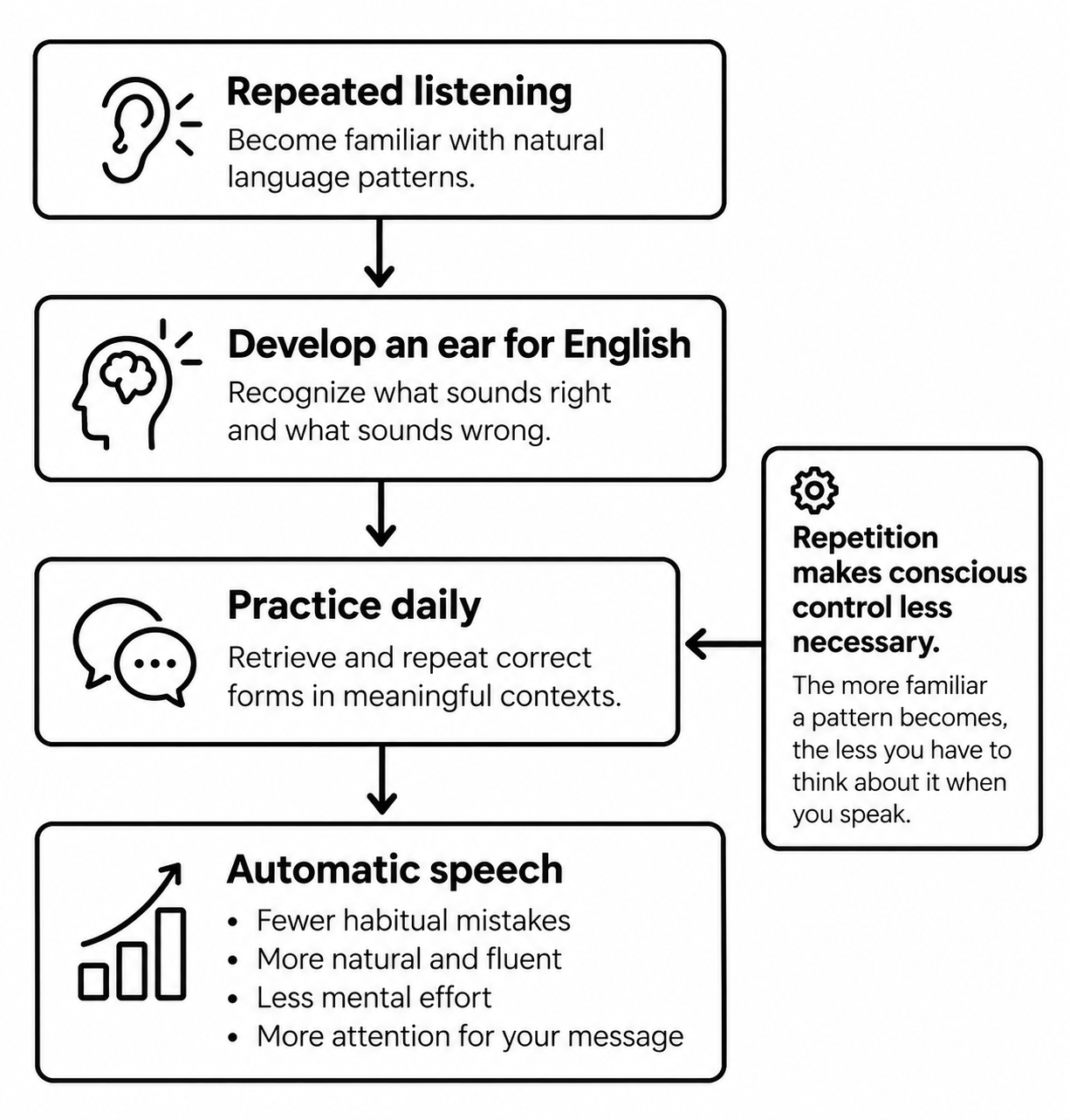
You don’t have to spend the rest of your life correcting your English.
Just by repeating patterns out loud in context, you can develop the ability to speak correctly without having to think about it.
So what does it actually mean to repeat language patterns out loud in context?
You need a clear plan for what to do during your daily study time, not just a general idea that you should practice more.
Coming up next: How to turn these principles into a practical daily routine.